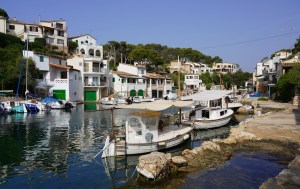
Cala Figuera, Mallorca
Photo’s are here or you can just click on the photograph above.
Highlights of Mallorca! Orange-flower honey, fresh sun-dried tomatoes in olive oil, sweet ripe nectarines and bright red cherries; coves (calas) with gin-clear turquoise water surrounded by spectacular rocky headlands; pretty historic villages in the Serra de Tramuntana mountains with colorful cobblestone streets decorated with terracotta pots filled with bright summer flowers; and bustling towns with vibrant weekly markets. There are walled fortress towns and fishing villages with whitewashed cottages and emerald green boathouses. Mallorca has some of the steepest coastal mountain roads in the world with hair-raisingly narrow switchbacks and expansive views over the Mediterranean. We spent five weeks exploring the beautiful (but in many ways, challenging) island of Mallorca. It was finally ticked off my bucket list but is unlikely to be revisited! That is not to say that we didn’t have a fun time because we did. We discovered some beautiful “happy places”, other places which were just OK, and then there were also a handful of places which definitely didn’t hit the “happy place” list at all 😂
Although the island of Mallorca is relatively small (it only takes an hour or so to cross from east to west, or from north to south) it is best divided into sections due to the varied terrain, the road system and the places of interest dotted across the island. It is undoubtedly a beautiful island with miles of rustic countryside and farmland dotted with olive trees, vineyards, orange groves and almond trees. It is equally famous for its fabulous rugged mountain range and rocky coves with golden sand beaches where you can swim in gin-clear turquoise waters surrounded by fragrant pine trees. There are some gorgeous villages and golden-hued towns with cobblestone streets and courtyards draped in bright geraniums and tubs of pink-flowering oleanders. On the opposite side of the coin there are some very unappealing places, an anti-tourist sentiment which borders on positively hostile and extreme overcrowding in some locations which are just short of imploding under the weight of mass tourism. Obviously we did nothing to alleviate the pressure of tourism by our own presence on the island although we did endeavor to remove our own trash from the beaches and deposit them in the correct receptacle – so many times we saw discarded cigarette butts and abandoned bottles of booze upended in the sand. Some of the tourists who come here are really not the kind you’d want in your own backyard.
Having said that, we were very grateful to have had the opportunity, the time and money to spend 5 weeks exploring this famous Mediterranean island. We spent 4 nights in an apartment with a pool in the town of Soller close to the northwest coast. Then 4 nights in a finca at the end of a dirt track in a remote part of the countryside in the northeast close to Artà surrounded by nothing but olive groves, dust, donkeys and dozens of wild tortoises which joined us around the pool every afternoon to sunbathe. It was a very odd place – with an eerie sense that it had been hastily abandoned some time back in the 1980’s – and here we were 45 years later in a dusty finca once loved but untouched since I was a teenager 😉. We moved to a much nicer renovated modern townhouse with a pool in the traditional agricultural inland town of Sineu for 6 nights.We had a large villa with a spectacular infinity-edge pool in the countryside close to the inland town of Muro surrounded by cornfields edged with blood red poppies and frothy white Queen Anne’s Lace for 5 nights. In the far southeast we had booked into a cottage in Cala Llombards on the coast for 4 nights. And finally we spent our last 14 nights in another large villa with a pool inland in the heart of the countryside between Inca (Mallorca’s “leather town”) and Sineu where there were more goats than humans!
Accommodation was one of the least successful (and frequently traumatic) aspects of our trip. Three of our original bookings were so awful we either left within a few days or we checked out minutes after checking in! It’s not always easy to find last minute emergency replacement accommodation when you’re sitting in the car in a village in the middle of nowhere searching for an internet signal in order to scour the Airbnb website. We abandoned one property before we’d even unpacked the car. Things looked pretty bleak for a while a couple of times with visions of having to sleep in the car for the night but we always managed to make contact with the owners of an alternative property who rushed over to prepare it for our unexpected arrival. What fun!
First world problems I guess but we struggled with the quality of our accommodations in ways we hadn’t expected for a European country and there was a definite whiff of mass tourist exploitation alongside the whiff of dodgy drains. We endured bathroom walls falling apart with mould and crawling with interesting many-legged wildlife; bathroom drains running behind the bedroom which was so poorly constructed and maintained that by night time we were sleeping with the waft of raw sewage around us. One place was so very far removed from its Airbnb photos that it was unrecognizable. Another was so dirty I struggled to put my suitcases on the floor, the sofa was (metaphorically) held together by stubborn stains and the kitchen appliances were decidedly battle worn and (actually) held together with sticky tape and rust. It’s a good thing I don’t mind woodlice because they absolutely love life in a damp dry stone finca wall! I wasn’t, however, quite so keen on the millipedes clambering up the kitchen walls in the morning. Buildings are so poorly constructed on the island that we often wondered how they remained standing at all. To think once I might have toyed with the idea of buying a finca in the countryside as a European summer bolthole! The water supply on the island is unfit for human consumption (the locals told us that they don’t drink it so we certainly weren’t going to) hence shopping involved hauling large containers of water every couple of days for drinking, washing food and cleaning teeth. This isn’t an obscure island in Southeast Asia. It’s an immensely popular European holiday destination in the Mediterranean! The drains in the villas were honestly worse than any we’ve endured anywhere (and that’s saying something). Even in the most expensive and the newest of our holiday villas the kitchen sink drain was so acrid our eyes were stinging and we were choking with the stench. Geoff conceded that there was nothing for it but to empty out the P-trap and clean it up himself. The standard of maintenance of rental properties and villas in Mallorca is the worst we’ve ever experienced.
One of our villas had 4 TVs – every one of them was broken; in another villa the speakers in the main TV in the living room had been completely blown out so all you could hear was ear-piercing static. The AC was touch and go depending upon the property. In our poshest villa the AC stopped working altogether after limping along in a sorry state for the first 2 days of our stay. Temperatures were hitting the mid 90’s°F/low 30’s°C with a predicted weeklong heatwave of 100°F/38°C on its way. We spent a hot and sweaty 36 hours slowly broiling to death before the owner was able to deliver 2 fans and 3 portable AC units. To be fair he did pull out all of the stops and suffered the same sleepless night we did since Geoff kept him updated on our misery throughout the night 😉. He arrived the following day with his portable units but since there weren’t any windows out of which to poke the exhaust hoses, he opened the 15 foot high sliding doors, shoved the hoses out of the gap and taped the rest of the space up with strips of cardboard. He told us that it usually takes a week for an AC company to get their butts into gear. Surprisingly, our AC company came out at break neck speed arriving at 11pm the following night … all seemed well, then the next morning it broke down once more so they returned at 10.30pm that night and worked until midnight again. Once the AC was finally sorted, all of the lights went out so we were plunged into darkness for 24 hours (thankfully the power to the AC was still working at least so we were no longer melting but we were padding around by the flashlight on our cellphones!). It might have been dark but at least it was cool 😊. The washing machine in the villa only worked if you turned it on and off 10 times (even then you couldn’t be quite sure it was going to kick into life) and you had to run everything through the dishwasher at least twice to achieve any level of cleanliness … very eco-friendly …
In this same remote villa surrounded by nothing but goat fields, dust and farms we were unlucky enough to have particularly bad neighbors for a long weekend who were staying at a villa a couple of hundred meters away. A group of 10 German millennials booked it for a huge party – they turned up the volume on their stereos, blared techno & garage music at full volume, got riotously drunk screaming, shouting, launching themselves into their pool and singing along at full volume to the lyrics. We complained to our host who tried his best to contact the owner of said villa who, in turn, did absolutely nothing. Our villa owner called the police who also did absolutely nothing because it was apparently not “the quiet hours”. If I said that Mallorca attracts the absolute worst of mankind I don’t think it would be unfair (and for once it wasn’t Brits causing all the problems – the Germans are just as bad) …
And don’t get me started on trash and waste collection! This was more Geoff’s territory than mine but, in a nutshell, the villas were varied but all equally un-user friendly. Some were equipped with one tiny trash can which would be filled by the end of every day and its contents therefore had to be disposed of the following day with whatever recycling we had accumulated. This meant that every single day we would have to take our trash out for a drive in the countryside with us whilst we went in search of a skip/dumpster. Skips are usually found at the side of country roads or on city streets surrounded by broken glass with trash billowing around your feet. All were redolent with the heady stench of rotting fruit, veg and meat scraps. There are different receptacles for each of the following: brown glass, green glass, clear glass, paper, cardboard, plastic, metal, food scraps and general waste. All were messy, overflowing and absolutely horrible.
In one of our rentals trash was actually collected from the roadside outside the house which was a novelty. In order to take advantage of this service we were provided with a complex list of do’s and don’ts with illustrations and complex charts which would have baffled a NASA scientist. The upshot of all this incredibly complicated over-regulation is that the locals tie up all of their daily bags of trash and dump it surreptitiously at the side of the road … which isn’t very surprising.
I could go on … but I’ve run out of energy 😂
Somewhere during the first half of our 5 week trip we were so disillusioned it was tough not to get on a plane back home to the first world 😉 … but we persevered and for all of its irritations we had a great time exploring the nicer parts of the island … you just have to pick and choose carefully. Wherever you go, however, it’s best to be prepared for a somewhat depressing level of unfriendliness – not least on the roads. Many of the drivers are pretty bad, aggressive and discourteous to other drivers – but if you’re a mere pedestrian then you need to watch yourself because Mallorcan “white van man” really likes to play human skittles with the foreigners.
Local Mallorcans running businesses are definitely far happier to see you and your money enjoying their island than is the general populace. The overall sentiment is not tourist-friendly (echoed by the increasing number of anti-tourist rallies being held on the island and across Spain). We can both get by with a bit of Spanish … we’re friendly and willing to engage with the local population … if we passed people early in the morning on quiet village streets we would always smile and say “Buenos días”. We were lucky to get a grunt in return … most often we were either ignored or sneered at. This attitude isn’t everywhere but the anti-tourist sentiment is certainly palpable in some places …
Geographically, the island can be divided fairly easily into logical sections for the purposes of exploring it. This didn’t work out for us quite as planned since all of our replacement emergency villas were pretty much as inland as you can get so some of our day trips meant hitting the tarmac early to avoid parking problems, overcrowding and heat.
Putting aside the negatives, there are some lovely places worth your time, effort and money if you visit the island 😊
In a nutshell, the capital of Palma lies on the southwest coast. If you drive north from the airport, the main artery road from Palma ends in the northern coastal town of Alcúdia. En route you will pass through the central agricultural heartland noted for its plains, vineyards, olive groves, almond trees and smaller traditional towns many of which are relatively untouched by tourism. The Serra de Tramuntana mountain range forming the northern backbone of the island is dotted with lovely small villages. It runs from Andratx in the southwest to the rugged cliffs of Cap de Formentor in the northwest. The terrain in the Serra de Tramuntana mountain range is wild, rocky and dramatic. The north coast is dominated by the Bay of Pollença and the wide expanse of the Bay of Alcúdia. Further east are the towns of Artà and Capdepera which are a long way from the traditional path of mass tourism. Continuing south from there, heading down the east coast, there are famous caves at Portocolom (the Drach Caves which we didn’t have the time nor the inclination to visit). As the route continues further south towards the beautiful rural south-eastern town of Santanyi, you will reach the region of Cala Llombards famed for its spectacular coves, fishing villages and the white sand beach of Es Trenc. Es Trenc is the island’s most famous beach which we also didn’t visit because it was covered knee-deep in seaweed and apparently has been for a long time.
1. Highlights of the Serra de Tramuntana – its mountain villages, towns and coastline:
a. Sóller (in the Valley of the Oranges) is a pretty town set against the fantastic backdrop of the craggy Tramuntana Mountains. It has some lovely quiet backstreets and a small busy, central plaza, Plaça de la Constitució, which is dominated by the cathedral Parroquia de Sant Bartomeu de Sóller. We stayed in Sóller for a few nights as it’s a great base from which to hike and explore. Our plans to hike were scuppered by the temperature, elevated even in the last week of May when we arrived. It was simply far too hot and dry to hike in the mountains. Culinary highlights in Sóller were Miga de Nube coffee shop and cafe where we sat under the cool shade of the orange trees in the terraced garden. The coffee was great and the fruits of the forest cheesecake was outstanding. We revisited a couple of times because it was such a peaceful place to escape the crowds of the main plaza. We also ate lunch at La Romaguera Restaurant at their tables set in a picturesque, narrow alleyway on the outskirts of town. It was one of the best restaurants we visited in Mallorca. Great friendly service, a beautiful location and amazing food.
You can ride the famous tram between Palma, Sóller and Port de Sóller but since it was only a 15 minute drive from our apartment in town to the port, we took the car and parked in the central multi-story parking lot close to the beach. Early in the morning it was lovely walking along the waterfront past the docks with traditional Mallorcan “llaüts” moored amongst the luxury yachts and motorboats. We walked as far as the older historic waterfront section with famous restaurants such as Kingfisher and Xelini where later we had tapas and cocktails for lunch. On one of the hottest days, we visited the port and swam in the water by the marina – not the most scenic of locations but needs must when the mercury hits 95°F/35°C in mid-June! 😉
b. Deià (one of the island’s poshest mountain villages) is very pretty and immaculately maintained. The locals are, however, very, very unfriendly … but it’s so lovely that we still visited twice! 😉 The first time we walked from the parking lot in town through the village and down to the famous cove of Cala Deià following the rocky dirt track downhill to the beach. Even in the last week of May it was 85°F/29°C but it was worth the sweaty effort to cool off in the crystal clear water in the cove. The quaint, rustic restaurant Ca’s Patró March presides over the cove and is famous as the filming location for the kidnap scene in ‘The Night Manager’. It gets busy down at the waters edge and rocky real estate was at quite a premium by mid-morning. We returned to Deià once more for breakfast at S’Hortet in the lower village which is an absolutely beautiful cafe with a very pretty garden with shady seating and a water feature – all very tranquil and calming. Breakfast was decoratively presented, the coffee was great and the lemon cake should be legendary. We chatted with the very friendly lady who runs the cafe for a while since we were intrigued by her accent. It was impeccable BBC broadcasting RP English. It turned out she was self taught in the English language, had lived in the cottage next door for her whole life and now uses her linguistic abilities to make her customers feel very welcome. Highly recommended – we loved it there!
c. Valldemossa is easily our favorite mountain village in Mallorca and scored 10/10 on our “happy places” list! The village is perched on a hilltop surrounded by neat rows of olive groves, almond trees and rugged mountains. The early morning view of the village from the winding route Ma-1110 is absolutely breathtaking. There is plenty of paid parking in the parking lot as you arrive into the village and more around the side streets outside of the residents only perimeter. If you can time your visit to arrive by 8.30am you’ll be alone with the locals running their early morning errands to one of the bakeries or watering their gardens. We wandered pretty much alone through the well-tended cobbled back streets admiring the colorful flowerpots. You might even have the opportunity to sit quietly under the shade of huge oak trees in Plaça Cartoixa which is dominated by the parish church of San Bartolomé. We saw it before the cafes set up their chairs and tables in the plaza – it was bliss – an entirely different world by 10am when it is bustling with life. There is a monastery, various museums and historical buildings to visit showcasing the local history and composer Chopin’s time spent here but for us the highlights were enjoying the peace and tranquility of the backstreets, the small but formally-designed garden Jardins Rei Joan Carles and, of course, grabbing an outdoor table in the shade at Plaça Cartoixa for coffee and breakfast at Barbaflorida. Later in the day we stopped for coffee and cake at one of the famous bakeries – Pastisseria Ca’n Molinas – it was awful and didn’t endear itself one iota when we saw a truck pull up outside to deliver mass produced supermarket cardboard boxes of pastries made somewhere in a factory.
d. Fornalutx is the smallest of the famous villages (billed as Mallorca’s prettiest village but we would disagree – that accolade should go to Valldemossa). It’s so tiny you can walk the entire place, stop for a drink, graze upon a plate or two of tapas and be back on the road in 30 minutes!
e. Pollença, in the foothills of the Tramuntana Serra, is a well-known British ex-pat enclave. It was larger than expected with a lovely old centre, a large central plaza and beautiful courtyards filled with cafes and restaurants. Like all good tourists we walked the 365 stone steps of El Calvari up to the chapel on the hill which overlooks the town. You can enjoy Pollença pretty much alone so long as you get there early, wander through the backstreets, grab coffee and breakfast at Bo’s Speciality Coffee (which was excellent) and walk the steps before 10am when the tour bus crowds start arriving. If you’re looking for a good bakery for supplies we found Ca’n Bisquerra bakery in the back streets. We weren’t so enamored of Port de Pollença (Pollença’s expansive beach area a few miles from town). It is very touristy, backed with hotels and cafes selling fish and chips and tapas. The sand was covered in neat lines of beach chairs and umbrellas for rent. Fine for an emergency swim but not of any greater appeal than that.
f. Cala Sant Vicenç was one of our happy places! It lies 10 minutes from Pollença. It is a small beach resort village with whitewashed buildings famous for its 4 coves nestled between the cliffs. Cala Barques is central to the beach resort and is quite pretty but backed by an enormous sprawling modern hotel. Cala Clara is tiny and covered in trash and washed up debris, so not ideal. Cala Molins is stunning with amazing water in every imaginable shade of blue and turquoise (also backed by a couple of large modern hotels). And finally Cala Carbó is undeveloped and by far the most beautiful. It has a small sliver of sand and as a result is much quieter without the ubiquitous sun-beds, umbrellas and various other beach-related rentals available on Calas Barques and Molins. Cala Carbó is surrounded by rocky headlands – the water is gin clear along this section of the coast and absolutely spectacular. If you’re heading straight to Cala Carbó to avoid the two more touristy beaches then you’ll need to get there early in the morning to bag one of the 5 or 6 highly prized parking spots directly overlooking the cove. We visited twice to swim and returned a third time only to find a brisk onshore breeze was kicking up rolling waves where it had previously been as calm as a millpond – and with it the waves had deposited huge swathes of seaweed. Relative paradise is, therefore, not always paradise! 😉
2. Highlights of the Central Region:
a. Sineu was an unexpected fortuitous find largely owing to our second emergency pivot on accommodation. We were homeless for a few hours until, after a number of urgent calls to an answerphone, the owner of the villa in Sineu we hoped to move to was located. He, his wife and his mother-in-law rushed to clean the villa and our new home was finally confirmed at 7pm on Sunday night (a day during which the whole of Mallorca appeared to be closed). This was a relief because we were having visions of sleeping in the car that night 😉! Anyway, Sineu is an attractive well-maintained small, rural town which sees some low-level tourism. There are a few boutique stores and cafes dotted through the side streets and in the central Plaza Des Fossar but mainly it is famous for its Wednesday morning street market – the only one on the island which sells livestock – hence it didn’t appeal to us.
b. Alaró lies in the foothills of the mountains and is a very popular destination for cyclists. It is a quiet traditional town with a small square, church and a town hall. We stopped off for afternoon drinks at El Trastero bar in the tiny but very quaint Plaça De Cabrit y Bassa and the following day we had breakfast at Can Fressa Cafe where we sat at tables on the edge of the plaza.
3. Highlights of the Northeast Coast:
a. Old town Alcúdia was another one of our very happy 10/10 places! It is a beautiful historical city which lies to the west of the Bay of Alcúdia. You enter the old town through one of 4 arched gateways in the 13th century medieval stone walls surrounding the town – we walked a small section of the elevated section of the walls starting at Porta de Mallorca but even at 9am it was too hot to walk very far. Back at ground level we preferred the shady cobblestone pedestrianized streets and alleyways criss-crossing through town and passing through Plaza de la Constitución which is lined with cafes and restaurants. We were heading for Malloria Alcudia – an excellent French cafe in a quiet courtyard dominated by a shady tree and a historic well. The focaccia sandwiches, coffee, cheesecake and pastries were all excellent (so good that we visited three times!). The cafe is very pretty, there are beautiful courtyard seating areas and the ambience is relaxed – we loved it! Market days are notoriously busy and crowded in Alcúdia since it is held within the old town walls along the narrow cobbled streets so good luck with parking!
Whatever you do, don’t bother with the Platja d’Alcúdia (beach) on the Bay of Alcúdia unless you’re looking for “British-style” fish and chip shops, the chaos which goes hand in hand with British Easyjet package deals in the sun, or you are happy to sunbathe with a fly-blown seaweed mountain piled high on the sand behind you. This definitely was not one of our happy places 😂
b. Cala Torta in the far northeast is in a spectacular remote bay with water as clear as glass. Fantastic for swimming but it requires hiking down (and up) hill through scrub and a rugged dry river bed for a mile or so. This was one of the beaches where it was obvious that the locals prefer to keep access as awkward and difficult as possible for everyone. Not long ago there was a carpark at the end of a dirt track down at the beach but that is now closed indefinitely. When we visited Cala Torta in May it was 88°F/31°C – quite warm to set off in the bone dry heat without absolute certainty where we were walking. Anyway, we parked at the top of the headland with all of the other tourists but there was neither a signpost nor an arrow pointing to the beach. We set off somewhat blindly from the carpark and bumped into a German couple looking as perplexed as we were. They had apparently tried 3 different hiking routes to get down to Cala Torta. Geoff studied his GPS and told them he thought he’d worked out the correct route but they headed off in the opposite direction. They should have followed him since he has reasonably good orienteering skills (cultivated since his years in the Boy Scouts 😉) and has only very rarely led us too far astray from our intended path.
c. Our half day with “Romantic Sailing” on their Wine and Tapas yacht trip to Cap de Formentor was a highlight of our 5 weeks on the island. The small yacht takes a maximum of 9 passengers. We shared the afternoon with 2 couples from Germany and another from the Netherlands who were fun and entertaining. We all sat shooting the breeze in the sunshine discussing world politics and learning more about each other’s respective country which was quite enlightening. The yacht sailed from Marina Bonaire in Alcúdia across Pollença Bay for an hour arriving at midday in a pristine cove on Cap de Formentor where we swam, snorkeled and tried our hand at SUP boarding before returning to the yacht for tapas and wine. The food was great and it was a lovely afternoon in a picturesque location. We were back onshore by 3pm.
d. Artà is in the far east of the island and if you don’t speak Spanish well enough to get by, then you probably won’t get by well here 😉 … unless you’re fluent in German since the Germans are busy buying up the town. There are some tourist shops, cafes and restaurants but the majority of people you pass on the streets are locals or German ex-pats. We tried the famous Mallorcan ensaimada snail-shaped pastry which is very soft and doughy and powdered with icing sugar at Ca’n Sarasate bakery and coffee shop.
e. Capdepera is a 10 minute drive from Artà where we meandered through the tiny 13th century fortress. It was small and inexpensive to visit and worth it for the views over the town and surrounding coastline. The town itself is attractive and, like Artà, is untouched by mass tourism.
f. Cala Mesquida in the far northeastern peninsula of Parc Natural de la Peninsula de Llevant is famous for its beautiful water but it’s surrounded by hotels and holiday apartments. The western part looks better suited to families with small children; whereas the eastern section is naturist. It was fine but didn’t make our shortlist of unmissable beaches.
g. Figueret Restaurant at Playa del Moro is a highly renowned traditional fish restaurant which we booked for lunch. It was excellent. Bookings are apparently essential since it’s very popular. Like everywhere on Mallorca it was still disproportionately heavy on meat dishes – surprising for a fish restaurant.
h. Blue Tamarindo Restaurant on the rocky waterfront at Son Serra de Marina was much better – less pretentious and more relaxed with beautiful views over the ultramarine waters of the Bay of Alcúdia, plus it has great food.
4. Highlights of the Southeast Coast:
a. Santanyí is small, compact, pretty and very peaceful. We really enjoyed wandering the streets when it was quiet and particularly revisiting it on market day which was very lively. There are art galleries and boutique shops in its pedestrianized streets but the main action is in the Plaza Mayor with Parroquia de Sant Andreu taking centre stage. We stopped for ice-cream at Sa Botiga which was excellent. The highlight of the weekly calendar in town is the Saturday morning market (a smaller version runs on Wednesdays). The line of parked cars stretches for miles on the main roads around town and the streets are packed with locals and tourists jostling for attention at the market vendors stalls. We stopped at the very popular Lozano Panaderia (bakery) stall and bought a loaf of tomato bread, a slab of fruit cheesecake and another slab of chocolate and walnut brownie (one of the best we’ve ever eaten). We sampled (and purchased) olives and cheese from a local farmer and orange honey from Georg’s gourmet grocery store. There are as many clothes and cheap jewellery stalls as there are artisan food vendors but it was a lot of fun exploring and weaving through the pedestrianized back streets searching out local delicacies to take back to the villa.
b. Cala Figuera fishing village is the prettiest coastal village on the island (a definite 10/10!). It has retained its authentic charm and is relatively untouched by tourism. The long, skinny harbor is protected in a bay surrounded by rocky outcrops dotted with pine trees. It is a working fishing community and immensely picturesque. Traditional fishing boats (llaüts) bob in the water against the backdrop of white-washed houses and green-painted boathouses – each with its own water slip into the harbor. We were the only visitors wandering the harbor at 9.30am and the only people we passed were locals working on their boats in dry dock. Absolutely idyllic!
c. Mondrago National Park is absolutely beautiful – we loved it – 10/10 on the “happy places” list! The deep finger bays of Cala Mondrago (also known as Cala Sa Font de N’Alis) and Cala S’Amarador are protected from the open sea by limestone cliffs dotted with pine forests. We arrived at the main car park (paid our €6 daily fee) and walked the rocky path down through the national park to the beach. It was a 15 minute walk. Arriving at 8.30am we could count our fellow beachgoers on one hand … by 10.30 it was us and 400 other sun worshippers, their kids and their kids’ inflatable beach toys. As more people streamed in every minute we decided to call it a day. It was absolute bliss for a while at least! 😉 The sand is super soft and the calm protected waters were absolutely fabulous – transparent teals and blues and warm enough to swim in for a couple of hours admiring the spectacular scenery.
d. Cala Lllombards boasts a couple of famous beaches, however, the village positively oozes anti-tourist sentiment and we wouldn’t recommend it all. This was a distinctly “unhappy” place for us and a definite low point in our trip – 1/10 on the “happy list”! Roads to the coast are closed off to anyone other than residents. This included people like us who were renting a cottage in the village (and thereby actively contributing to the local economy rather than simply driving in as a day tripper). We scoured the local news for an explanation of the extensive road closures and barricades surrounding us and discovered that one of the manifesto promises of the mayor of Cala Llombards was to make it extremely unappealing for tourists to visit the area – she’s doing a great job!
- Cala Lllombards beach is ridiculously busy. The car park is packed to overflowing by mid-morning. We had to pick our way to the waters edge over semi-conscious badly sunburnt bodies strewn across the sand surrounded by beer cans, upturned bottles of booze and discarded cigarette butts. To achieve a more balanced view we visited again early one morning at 8am. There were very few people at that time of day which was a bonus. Geoff leapt into the water from the rocks only to leap straight back out again when he was stung by a jellyfish with 5 feet/1.5 meter tentacles. We watched as the picturesque boathouses to the left of the cove were roped off with ticker tape and ugly yellow barriers to prevent would-be sunbathers from sitting on the rocks next to the green boathouse doors. Nowhere screamed “tourists go home” more than Cala Lllombards. In some ways I can understand the negativity because some of the visitors which the beaches attract are perhaps less than desirable but the animosity towards all tourists overall is palpable here.
- Cala des Moro is a tiny spectacularly pretty cove but, with hindsight, is not really worth the effort to visit. It is a 20-25 minute walk from the newly designated parking lot which isn’t much fun in 95°F/35°C. The road closures I mention above are aimed specifically at restricting access to this beach and its neighboring beach, Cala S’Almonia. The locals protested about tourism quite vehemently earlier this year and the upshot is that the local authorities have made it as hard and unappealing to visit as possible. Once you’ve walked the tarmac roads for a couple of miles (without any shade whatsoever in the baking heat) to the end of Carrer des Calo des Moro there are steep stone steps ahead of you which descend to Cala S’Almonia. At the bottom you see a tiny cove to the right and a picturesque bay surrounded by rugged cliffs. The water is clear and turquoise. To the left are a couple of stone and white painted boathouses. If you continue around the headland to the left you will follow a dirt track edged on both sides by tall purple flowers and scrubland. Once you have reached the clifftop you will see the narrow strip of sand at Cala des Moro below you – a small cove of white sand and transparent glasslike turquoise water protected by rugged, limestone cliffs. You have to descend a short, steep, sandy, rocky path (best avoided in flip-flops!), The cove is very pretty but even by 9am it was busy with streams of people descending the narrow pathway to the increasingly overcrowded beach.
- Cala Santanyi beach is equally as busy and is backed by hotels and bars. The sand and water are beautiful and the views from the walkway at the far right end of the beach were pretty as were a small group of green painted boathouses around the corner. The rugged, rocky headlands were packed with bodies lying on towels. Not really our kind of place as it was so overcrowded. We stopped for lunch at S’Ona Beach Restaurant and shared a huge pan of paella (cuttlefish, prawns, mixed vegetables and clams) with a cheeky sparrow which landed on the table, sidled up to the sauté pan, pecked a few pieces of rice and flew off to feed its chick hiding in the bushes next to us.
e. Cala d’Or and its various beaches. What a breath of fresh air – 10/10 on the happy list! There weren’t any stickers – nor any grafitti – telling “rich tourists” to go home, nor parking lots closed off to non-resident vehicles. On the contrary, the road into Cala d’Or is lined with lampposts adorned with flags welcoming tourists in 6 different languages. There is free car parking almost everywhere and large enough parking lots close to the beaches so that if you get there by 8.30am you might just get lucky! We picked Cala Esmeralda (one of several of Cala d’Or’s various beaches). A small but perfect cove backed by whitewashed villas and apartments. We arrived early and shared the beach with a small handful of other tourists. There was plenty of shade early on, the water was pristine and the beach was clean – what a bonus! After a few hours it was busy by 11am so we packed up, and drove a short way up the coast to see the fishing cottages in Portocolom (really only worth a drive if you’re passing) and then headed south to the very posh and exclusive Marina de Cala d’Or. The marina, filled with yachts and rental boats is enveloped by very upmarket white painted apartments and restaurants overlooking the water. We had lunch and cocktails at Yaya’s which was great for a relaxing lunch. We revisited Cala Esmeralda again a week later since we liked it so much – but by then we were well into German school holidays. We arrived by 8.30am. It was packed by 10am but still fantastic to swim for a few hours. There wasn’t a puff of wind and the water was so calm it was like swimming in a giant aquarium. We were surrounded by saddled seabream and if we stood still long enough we were gently nibbled by tiny almost transparent juvenile fish. This part of the coast was one of our favorites!
5. Highlights of the Southwest Coast:
a.The town of Port d’Andratx is lovely and a world away from the inland town of Andratx which lies a few miles into the hills. The Port is upmarket with an attractive waterfront and pricey boutique stores. The bars and cafes overlooking the beautiful harbor were frequented by elegant, well-dressed “ladies who lunch”. We stopped for cocktails at Latitud 39 to admire the view and absorb the ambience. The hilltop town of Andratx was, by comparison, possibly the most disappointing and unattractive town we visited with seemingly very little to recommend it – surprising given it’s a well-known ex-pat town.
b. Cala Fornells lies west of Palma. The cove and its neighboring cove, Platja Caló de ses Llisses, were very beautiful. There are hotels built around the cove which make it a busy location but if you get there early enough you might enjoy it for a swim before the pink inflatables ruin the view 😉
c. The capital of the island is Palma de Mallorca which lies within the Bay of Palma. With its daily influx of cruise ship passengers (there were 3 gigantic ships in port when we visited one morning) it is a busy city. We fought our way through the crowds, catching our breath in the narrow alleyways away from the streams of humanity. Tour guides waved placards above their heads as they herded their passengers from one location to the next. We wove our way through the back streets of the old town to the huge Cathedral of Santa Maria of Palma famous for its stained-glass rose window. Cafes and restaurants line the streets and avenues of the old part of the city. Aficionados recommend coffee at El Grano de Cafe (it was very good). There is also another branch in Santa Catalina. We bought almond croissants at the highly rated Fika Farina coffee and bakery and I couldn’t resist whipping in to iconic Ca’n Joan de s’Aigo bakery for an apricot croissant (both bakeries were excellent). Ca’n Joan de s’Aigo is clearly on the tour bus route but don’t let the groups of people milling about outside sampling free ensaimadas put you off venturing into the interior if you can battle your way through them to the door. The original cafe (located in Calle Sanç) is in a beautiful old building with painted tiles on the wall and an authentic historical ambience. We visited Palma again later in our 5 week trip, specifically the trendy area of Santa Catalina which I had read was a “hip enclave”. At the heart of the community is the Mercat de Santa Catalina – a marketplace with excellent gourmet food stalls, flower stalls and vendors serving tapas to diners seated at busy bars inside the market. It is a pretty cool neighborhood with street cafes and coffee shops and a couple of famous windmills overlooking the marina and the city. Because it is also the centre of nightlife in Palma the street corners of Santa Catalina double (unfortunately) as public conveniences and in the heat of the day in late June it was like walking though an open-air mens urinal (quite revolting 😉). However, we ended our visit to Palma on somewhat of a high at an excellent fish restaurant, Can Eduardo (recommended by one of Geoff’s friends), which overlooks the marina. Service was unfriendly (no surprise there!) and a little snooty but the food was absolutely awesome! At least we could leave the capital behind us feeling somewhat positive. Overall, not one of our particularly “happy places” 😂
6. Spectacular drives in Mallorca:
a. Sa Calobra (also known as the Snake Road) is one of the major highlights of the north. The drive down to Sa Calobra cove is a short 8 miles/13 kilometers with an average gradient of 7.1% – it is famed for its 26 utterly hair-raising hairpin bends. The road is a testament to engineering and renowned as one of the windiest in the world. It is a spectacular drive but not one for the uninitiated to tackle since it’s frequently too narrow for 2 cars to pass (let alone a car and a tour bus meeting on a blind bend). I held my breathe for much of the journey since there is little protection between you and the abyss! It is a hugely popular cycle route which is impressive in itself given its insanely steep gradient. Sa Calobra runs through the mountains with breathtaking views of Mallorca’s highest mountain, Puig Major and its surrounding rocky landscape. We drove in and out before 9.45am to avoid the influx of tour buses and bad drivers with which it is apparently plagued for most of the day.
b. The route Ma-10 runs from Pollença through the mountains via Lluc, Biniaraix, through Soller, Deià, Valldemossa and from there it heads out to the coast to the peaceful town of Banyalbufar. By default we must have driven sections of Ma-10 half a dozen times between the villages but nowhere is it as dramatically spectacular as the section between Valldemossa, Banyalbufar, the town of Estellencs and the hilltop town of Andratx. The coastline is simply stunning. The road weaves through switchbacks high along the coast revealing incredible vistas of undulating pine-covered rocky headlands descending to the ultramarine sea. Banyalbufar (in Arabic “vineyard by the sea”) is one of the few remaining truly authentic Mallorcan villages. It is famed for its steep terraced hillsides which have been in use since the Moors created the terraces to grow Malvasia vines. Now it is better known for its tomato crops. Further on you pass through the small rustic settlement of Estellencs overlooking the rocky coastline – again as far removed from mass tourism as it is possible to be in Mallorca. It is an unmissable drive!
c. If you are a very confident driver you can also navigate the insanely narrow Ma-1131 down to Port de Valldemossa from the hilltop village of Valldemossa. In theory it is a two lane road running through the mountains – it even has a neatly painted white dividing line – but in reality, the road is barely wide enough for one vehicle let alone two. The obstacles to avoid are numerous – jagged rocks hanging into the road, non-existent visibility around the bends and steep switchbacks. Thankfully we didn’t meet any vehicles either driving down to the port nor up again which was a great relief because it’s hard to imagine where you could safely pass if you met another vehicle head-on. It is not a popular tourist village presumably due to its relative inaccessibility and once we made it to the bottom there were only a tiny handful of people there – a couple of fishermen working on their boats, some locals swimming in the harbour, a few people drinking beer at roadside tables in the bar and a lone kayaker.
d. Another iconic Mallorcan drive is the Ma-2210 from Pollença through Cap de Formentor peninsula to Cap de Formentor lighthouse. It is probably the most famous route on the island. In typical anti-tourist style the government closes the road to all drivers (except for residents or authorized vehicles) from June 1st until October 31st between 10.00am and 10.30pm subject to weighty fines. If I’d known that earlier we could have driven it when we arrived in late May but the constant changes of accommodation made planning difficult so we missed our chance! You can catch a shuttle bus instead of driving it which takes an hour each way … this didn’t appeal greatly so we passed on checking out this famous viewpoint!
In summary, if you’ve made it this far, you’ll have guessed we really struggled with some aspects of the island. We had a great time exploring Mallorca and really enjoyed it overall but the trip was somewhat overshadowed by the negatives. I must be the only Brit who’s never been to Mallorca before (even Geoff visited decades ago in his wayward youth but he never made it any further than Magaluf – so that doesn’t really count 😂) so I have wanted to visit for a number of years as I have heard so much about its natural beauty and charms. Undeniably, Mallorca certainly has plenty of natural beauty but I fear that its charms are fast-fading with unsustainable levels of mass tourism which is clearly impacting the natural environment and the island’s ability to provide the levels of accommodation and sanitation (amongst other things) that you might expect in other parts of Europe. Together with the rise of anti-tourist sentiment in Spain (and particularly in Mallorca) these problems make Mallorca far less appealing overall than other regions on the European continent – which is unfortunate because it really is very beautiful in places!
Categories: Alaro, Alcudia, Andratx, Arta, Banyalbufar, Cala d'Or, Cala des Moro, Cala Esmeralda, Cala Figuera, Cala Fornells, Cala Llombards, Cala Mesquida, Cala Sant Vicenc, Cala Santanyi, Capdepera, Deia, Europe, Fornalutx, Mallorca, Muro, North America, Palma de Mallorca, Playa del Moro, Pollenca, Port d'Andratx, Port de Valldemossa, Portocolom, Santanyi, Sineu, Soller, Son Serra de Marina, Spain, Travel, Valldemossa
 AVID WANDERERS: GEOFF & JENNI'S TRAVEL BLOG