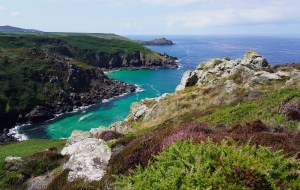
Zennor Head, Cornwall, England
Photo’s are here or you can just click on the photograph above.
Time to start one of our long-awaited retirement dreams – exploring the coastal county of Cornwall for an extended 6+ week trip. Leaving our various friends and their sweaty heatwaves behind us we headed south. En route to the very end of mainland England we detoured for a superlative lunch at The Farmers Arms. The pub is part of “The Collective” at Woolsery, a village in North Devon (as mentioned in our previous blog).
Cornwall (arguably England’s most beautiful county) lies in the far southwest of England. It is a land of excruciatingly narrow, winding country roads hedged 15 feet high on both sides by impenetrable bushes, brambles and stone walls – all likely to cause extensive damage to the paintwork of your rental car 🤪 If you are planning to drive the country roads then you’d best be good at emergency stops and rapid reversing for 200 feet backwards around a blind bend … and you’d better remember if you passed a stretch of road just wide enough to take 2 cars without causing extensive damage! Farm tractors will barrel towards you at full speed on single track lanes and millennials will careen around bends with no thought as to what might happen when two cars meet head on at a blind bend with a joint speed of 70mph. The speed limits will be 60mph or 70mph when they should be 20mph. Honestly, driving these roads is frequently terrifying. To make up for it, Cornwall is also excruciatingly beautiful and dramatically spectacular; it is wild and dangerous with an unpredictable subtropical climate which lurches between brilliant blue skies, rain and, in winter brutal storms.
Bright blue hydrangeas grow wild in the summer together with wild flowers in every shade of blue, purple, pink and yellow; the headlands are red with berries intertwined with apricot-coloured honeysuckle and ferns grow emerald green dotted amongst purple heather. The beaches glow gold in the summer sunshine and the waters of the English Channel (to the south) and the Atlantic (on the north coast) are as turquoise and transparent as any in the Caribbean (if only they were as warm 😉). There are many beautiful places in England but few as breathtaking as Cornwall on a sunny summer’s day.
Then, of course, there are also Cornish Cream Teas with clotted cream and strawberry jam (jam first in Cornwall!), homemade clotted cream fudge, Cornish butter, ice-cream and cheeses from the local farms, and fresh blackberries picked from the hedgerows in the countryside … everything tastes better in Cornwall! 😊
To make things logistically easier we divided our time between the following regions:
- The Land’s End Peninsula:
a. Sennen and Land’s End. We started our 6 week visit in Sennen in a house on appropriately named Sunny Corner Lane. At the end of the lane we could clamber down steep sand dunes and descend onto Sennen Beach. The beach is backed by high grass-covered cliffs and sand dunes at one end and at the other end lies Sennen Cove village. If you continue on through the village passing the distinctive Round House and a pretty white thatched roof cottage with sky blue shutters (Capstan Cottage) and the harbour you can head uphill on Mayon Cliff through banks of bright orange Crocosmia flowers before joining the South West Coast Path. At this point you can head south towards Land’s End. It is an easy route with wide tracks over the headland – very possibly the most frequently walked route in Cornwall since it is not a long walk (less than 2½ miles return) and it is fairly accessible to all. There are lookouts over the sheer cliffs, an iron age fort and The First and Last House. We didn’t bother with the National Trust operated Land’s End Peninsula because it’s very touristy and correspondingly overpriced to visit. The joy of the walk is not always in the destination but in the views along the way meandering amongst the pink Sea Thrift and the purple Cornish Heather!
b. Treen is a tiny hamlet close to Sennen on the south coast (there is another on the north coast close to Zennor) where friends of Geoff’s live for part of the summer. Christian comes from a long line of Cornish fishermen with family roots deeply embedded in the region and now that he has retired from his corporate job traveling the world with his family he spends his time fishing off the coastline so that lucky guests (like us) can visit him and his wife Paula for dinner! We had freshly made Thai fish cakes and sea bass fillets with vegetables picked from his father’s garden – it was fabulous. There is nothing quite like living off the spoils of the land! Treen is also one of our happy places from our visit to Cornwall 8 years ago when we were in the area for a few days so that we could visit see our actor friend Dave performing at The Minack Theatre in Porthcurno. During that visit we took a walk out onto the Treryn Diras Headland from Treen village towards Logan Rock. Back then, looking towards the west over Pedn Vounder Beach was akin to gazing down onto a Caribbean beach (only the Atlantic is at least 60°F/15°C colder). It is critical to catch it at low tide for the full Instagram-fabulous effect. The white sand shone against the green headland and the shallow transparent waters were bright turquoise. We weren’t quite so lucky this time since the tide was high and the shallow pools were submerged in deep water. Either way it is still a spectacular place albeit now crowded beyond recognition on a sunny day (the National Trust has recently closed it due to the risk of environmental damage – which can’t be a bad thing!). Back in the tiny village of Treen there is a pretty whitewashed cafe with a red and white striped awning out front called Farm and Fort Cafe. It is located next to the entrance to the car park for the headland and for people making the steep hike down to the beach. The coffee and cakes were so good we visited a couple of times just to hang out. The Logan Rock Inn is very well-known in the village. It is highly photogenic – covered in vibrant flower-filled hanging baskets but from my memory of 8 years ago it didn’t excel with its food – worth a drink but I wouldn’t willingly choose to eat there again!
b. Mousehole is a delightful and very popular tiny fishing village with little more than a few shops, cafes and restaurants. The harbour is idyllic on a beautiful day with the sunshine glinting off the sea and fishing boats bobbing in the harbour at high tide. Luck wasn’t on our side, however. It was cloudy, grey, gloomy and nowhere near as idyllic as I would have liked 😉
c. Marazion is the oldest chartered market town in Cornwall – incorporated in 1257 by Henry III. It is a small town which is situated in Mounts Bay most famous for St Michael’s Mount – a tidal island dominated by an imposing castle and gardens. The Mount is operated by the National Trust and is accessible on foot only at low tide via a stone causeway – best not to get caught out with an incoming tide without your running shoes on 😉
d. Penzance is a reasonably attractive town with a lot of independent stores and cafes in its historic centre. We stopped in for coffee at Wren and Raven which is a trendy cafe at the top of the hill and was worth a visit. The Cornish Hen Deli next door is a perfect little deli with excellent homemade quiches and cakes which I highly recommend if in you’re in town!
2. The Lizard Peninsula:
This is our favorite region of Cornwall and the one where we spent most time.
a. Cadgwith is a quintessential traditional Cornish village on the east coast of the peninsula. Less a tourist destination than a working port but since it’s so picturesque there are always tourists photographing the colorful fishing vessels down in the cove. The view from the rocky promontory, known as the Todden, over the harbor is perfect. We loved Cadgwith and hiked the South West Coast Path in both directions from the cove.
The first time we hiked south passing the Devil’s Frying Pan, Church Cove, Bass Point, the crenellated Lloyds Signal Station building and Housel Bay on to Lizard Lighthouse and the famous Lizard peninsula, the southernmost point of Great Britain. The scenery was fantastic and wild flowers lined the trail. We stopped at “Coast” in the village for lunch (which was great if not pricey) and then took a shorter route back to Cadgwith navigating footpaths across the fields. The round trip was 8 miles and well worth the effort.
The following afternoon we hiked north from Cadgwith Cove towards Kennack Sands. It was too hot to hike far so we bailed on walking to the beach and stopped instead to enjoy the wide-angle views from the headland. Cadgwith Cove Inn across from the harbour is worth a beer after a long, hot walk.
b. Coverack is a small village with a tiny but pretty harbour with a handful of fishing boats moored within its protective walls. There is a wide expanse of beach just before you reach the harbour which is protected from the elements by the surrounding headlands so the water was calm enough for swimmers, kayakers and SUPers.
We hiked from the Cove at Coverack over the Chynhalls Point peninsula and up onto the heathland on Coverack Headland in a circular walk which passed the Terence Coventry Sculpture Park and crossed grassland back down to the village. Beautiful for a late afternoon walk.
The Lifeboat House Restaurant with its huge picture window overlooking the sea serves excellent seafood chowder and fish and chips. The bizarrely named Paris Hotel (also at the Cove) was a little more average but just as popular – the bonus was the beer garden where we watched kayakers gliding over the water in the early evening sunshine and the sun setting over the Chynhalls Point peninsula.
c. Kynance Cove is a stunning coastline protected by the National Trust. It is free to park if you’re a National Trust member – otherwise it’s £10 to park per visit. I lost track of the number of times we visited during our initial 10 days in Coverack and then again during our subsequent week in Mullion. Hiking in either direction is absolutely spectacular. The Instagram-famous beach is surrounded by huge rock stacks and is very popular at low tide when the golden sand is revealed. The water is turquoise and the coastline is very dramatic with sheer cliffs and grassy headlands with swathes of wild flowers – pale pink Cornish Heath (specific to the Lizard), white oxeye daisies and purple Bloody Cranesbill.
Our first hike from Kynance Cove was south towards Lizard Point past Pentreath Beach (a spectacular sweep of sand with turquoise waters). At Lizard Point we stopped for coffee and cake at Wavecrest Cafe with terrace tables overlooking the cliffs and the ultramarine sea. The food is very good, it has a relaxed and friendly vibe and it’s extremely popular with hikers and families. In fact, it is so good that we returned again for coffee and cake a few days later after walking the trail early one morning from Kynance Cove. We bought take-out sandwiches and sat on a rock for lunch mesmerized by the waves and the sunlight glinting on the sea. We also hiked mid-morning one day and stopped there for a full English Veggie breakfast which was similarly excellent! You can retrace steps as often as you like on the headland tracks in one region and it never looks the same – sometimes there is sea mist softening the horizon, sometimes brilliant sunshine but the light is always different and the ever-changing tides either reveal or swallow beaches whole changing your entire perspective. Whatever the weather it was always spectacular!
We also hiked north from the National Trust car park following the steps down to the sand, clambering over the rocks and the sandy beach in front of Kynance Cove Cafe, and up the stone steps on the opposite headland which overlooks Mermaid Pool. We continued uphill and onwards towards Predannack Head (which was absolutely beautiful) and Mullion. The view back towards Kynance Cove and Asparagus Island in the mid to late afternoon light was breathtaking. The water is so clean and transparent that we could see (even from our lofty clifftop viewpoint) seals playing in the water and diving down into the weeds. The sea was perfectly still and an SUPer paddled out into the bay in our direction and stopped to watch the seals. Their heads popped out of the water to check her out and swam over to her. It must have been quite magical!
d. Poldhu Beach Cove to Mullion Cove via Polurrian Beach. This was a pretty 4 mile return walk – part roadway, part clifftop and not very challenging which was a definite bonus. This made it all the more surprising the second time we hiked it that we were so exhausted by the time we returned to the car. On a cloudy day it was easy – but when the mercury rose to 78°F/25°C and there was no accompanying sea breeze to take the edge off the heat, the hike was infinitely more hard work!
e. Porthallow Beach, although pretty at sunset, is an unassuming grey sand and stone beach just north of Coverack which oozes tranquility if you want to dangle your fishing line in the water and feel as if you’re a million miles away from the rest of the world.
f. Praa Sands Beach in Helston is a huge sweeping sandy beach lying between rocky headlands. I didn’t warm to it at all at the car park end. It was pretty commercialized and the sand was scattered with windbreaks and kids beach toys. However, if you walk along the sand in a southerly direction towards Porthleven it was completely empty save for a couple of dog walkers. You can explore the rock pools between the huge smooth rounded granite boulders in shades of white, gold and black. It was quite beautiful away from the masses!
g. Porthleven is another quaint fishing village with the most southerly working port in the United Kingdom. Whilst it is not quite as pretty as the big hitters like Mevagissey and Mousehole, it is very popular all the same with kids swimming in the harbour and the usual plethora of ice-cream stores and cafes. The 200 year old historic harbour is impressive in scale and backed by rows of white-painted Victorian villa style houses with colorful facades. Since the harbour faces south west into the prevailing winds, the sea defenses there are massive. Porthleven is a popular place for storm watchers in winter when they come to see huge waves crash over the sea walls.
h. Bonython Estate Gardens, Helston. We stayed in East Lodge cottage with a garden, a summerhouse and an outdoor jacuzzi at Bonython Estate. The walled garden was absolutely beautiful with raised beds, abundant cottage garden flowers and a small lake with acres of tranquil grounds. There is a thatched building close to the walled garden which sells homemade cakes (which alone would make it worth a visit!).
i. Longstone Barn, St Keverne is a picture-perfect converted barn with all of the necessary mod cons. It is bijou but with the prettiest privately-owned cottage garden I’ve ever seen – a work of art filled with bumblebees, butterflies and honey bees. We stayed for our first 11 nights on the Lizard Peninsula and absolutely loved it.
j. On the important matter of food in the locality – Vicky’s Bread and Ann’s Pasties (the latter also has stores in various places) are conveniently located next door to each other in the tiny trading estate of Tresprison in Helston. Both are so good that we drove miles out of our way on several occasions for Vicki’s sourdough and for Ann’s veggie pasty and millionaire’s slice. The Cornish Bakery is also great for Cornish pasties and has various outlets in all of the hotspots. Roskilly’s Farm, Cafe and ice-cream shop are iconic in these parts. It was by far the most boring ice-cream we’ve ever eaten. Not worth the calories and barely worth the journey if it weren’t for the fact that you can wander through the fields and meet their cute pigs and goats. Our top-tip for farm produce, homemade cakes and small batch homemade ice-cream is Treleague Dairy in Ruan Minor – very small but top quality. Our favorite cafe for coffee and cake after a long hike to and from Kynance Cove to Lizard is Wavecrest Cafe for top quality coffee, cakes and breakfast with a spectacular clifftop view (as mentioned above!). If you don’t mind being metaphorically robbed then the food is very good at Coast Coffee Bar and Bistro in Lizard village but it is a tad overpriced – even for Cornwall! Trevithick and Trays Farm shop has a great deli with local produce. The Greenhouse restaurant in St Keverne is by far the best local restaurant we tried out – on recommendation by the owner of our barn cottage; and, as mentioned above The Lighthouse Restaurant in Coverack was really good for more family style dining.
3. St Ives Bay:
a. St Ives is one of the most well-known towns in Cornwall – famous for its Tate Modern Art Gallery, beautiful golden sand beaches and its sizable historic harbour. It is probably the most popular summer vacation destination in the country for Brits as a result of which it is very expensive and very busy. If you arrive at 8:30am (as we did) then you might get lucky and snag one of the parking spots in town. We parked at the harbour at Smeatons Pier for the princely sum of £9.50 for the day which is not exactly cheap, but it was very convenient for wandering through the back streets, mooching along the harbor and walking the short coastal path around The Island to the most famous of St Ives’ beaches – Porthmear beach.
If you do manage to make it into town in the early morning you might enjoy the ambience with only a handful of other early risers and vacationers renting one of the many fisherman’s cottages in town. Rest assured, by the time you’ve wandered aimlessly – picked up some critical supplies from the excellent St Ives Bakery (or The Makers which sold very elaborate cakes at elevated prices), grabbed a coffee and had a natter with the locals in the tiny but very cosy Mount Zion Coffee shop – then you’ll emerge into a rather different world by 10:30am. The beaches will be covered in striped wind breaks in various gaudy shades of blue, yellow and red and the streets will be jammed with a conveyor belt of tourists, their screaming kids, ice-creams dripping down their arms and all over the pavements and seagulls dive-bombing at tourist’s Cornish pasties as they huddle in groups on the wooden benches along the harbour front.
Having said that, you can always escape the crowds (which is an enormous bonus) if you make the effort. The headland walk was pretty empty – there is a small coffee shop in the churchyard at St Ia with benches overlooking the sea – and there is a lot of open space on the expansive Porthmear Beach which is popular with body boarders and surfers – but that’s about it – from 10:30am onwards the town streets are as packed as a U2 concert!
I mentioned that we parked at Smeaton’s Pier on the harbour-front early in the morning … it seemed like a great idea to park at the pier when we arrived but, of course, the cobbled streets are ridiculously narrow and once the whole of the British Empire has descended upon St Ives in the height of the summer it is quite a challenge to navigate through the hordes with a large SUV car. It was a challenge not to squash small children in prams and family dogs running amok as you squeezed past them, their backs squashed against the walls of shops and cottages.
Beautiful – but go early – or preferably out of season … and (as with all of these famous harbour towns and villages) try to time it with a high tide so that you’re not gazing upon colorful fishing boats lying lopsided in a sea of brown mud!
b. Zennor is a teeny tiny hamlet a short distance west of St Ives boasting The Tinners Arms – a 13th century pub, St Senara’s Anglican Church, a Moomaid of Zennor outlet selling premium ice-cream and a tiny handful of houses and farms. The Mermaid of Zennor is a Cornish folktale about a beautiful mermaid who was entranced by a young man she met at St Senara’s church with an enchanting singing voice … legend has it that she lured him into the sea and neither of them were ever seen again. The highlight of our visit was hiking at Zennor Head which was unexpectedly jaw-droopingly beautiful. Having done so much hiking around Land’s End and The Lizard Peninsula (which are renowned for their dramatic, spectacular rocky coastlines) we didn’t expect Zennor (a place neither of us have previously visited) to be so especially stunning. As short walks go, this one certainly packed a punch. From the main car park next to The Tinners Arms we followed the sign for a mile or so down a tarmacked road until we reached the intersection with the South West Coast Path. A few steps further over the heath on the headland and the view from Zennor Headland opens up over Pendour Cove, Carnelloe Headland and as far as Gurnard’s Head (a rocky promontory which juts out into the Atlantic sea). Without doubt that view in the early afternoon sunshine will stay with me forever – it was my favorite hike in Cornwall which (given the number of incredible hikes we did with superlative views during our 6 weeks there) is saying something …
A few weeks later we returned to hike the section of coast between Gurnard’s Head and Zennor Head which was equally as breathtaking and, for a short 4 mile return hike was pretty tiring. There was quite a lot of elevation gain (and coinciding descents) together with clambering over rocky and uneven terrain. It was somewhat of an obstacle course with the path crossing over small streams, slippery mud and awkward rocks all designed to cause a nasty twisted ankle. It was, of course, definitely worth the effort especially when you can relax post-hike in the Gurnards’s Head pub with a pint and a top gastro pub quality lunch 😊 (see below).
c. The Gurnard’s Head is a renowned old coaching inn on the road between Zennor and St Just with a beautifully atmospheric interior and, for sunny days, tables in the garden overlooking the Atlantic. It is easy to spot the pub from a few miles away across the fields from the main road because it is painted bright sunshine yellow! The food was amazing. We stopped in for lunch after hiking at Zennor Head. The owners are two brothers who also own the iconic restaurant The Old Coastguard Restaurant in Mousehole. The emphasis is on fresh, locally sourced ingredients presented with a flair. It was our most memorable meal during our two months back in England. In fact, it was so good we returned twice. Highlights were the red gurnard, onion, cucumber and chilli ceviche, the fish cake with poached egg and hollandaise sauce, the crab focaccia sandwich and the chocolate mousse. All were to die for!
d. Upton Towans/Gwithian Beaches with Godrevy Head to Hell’s Mouth. If ever there was a headland to walk late afternoon towards sunset this is it. There are sweeping views from the sand dunes in either direction along the 3 mile stretch of beach, there are rock pools for the kids and rolling waves for the surfers and body boarders. It is an absolutely gorgeous stretch of sand! A little further around the coast is Godrevy Head where you can watch seals resting on the rocky beach way below at Mutton Cove and if you fancy a longer hike you can continue on around the South West Coast Path to Hell’s Mouth – but don’t bother with the Hell’s Mouth Cafe – it was very average – so bad in fact that we had to send our cake back for a refund (which is all but unheard of 😉). Whilst we meandered the headlands around Gwithian Geoff couldn’t resist picking a few wild blackberries … he ate a few … picked a few … and by the end of the walk he’d filled a bag with about 5lbs of them!😊
e. Carbis Bay has a beautiful swathe of golden sand backed by emerald green headlands and posh apartments. It is considered one of the more upmarket second home enclaves close to St Ives (I’d certainly consider it if the budget allows 😉)!
f. Church Cove to Fishing Cove, Gunwalloe beach. We parked at the National Trust car park at Church Cove and walked the small circular route on The Mound headland in almost gale force winds (don’t let the sunshine in the photos fool you – the wind was strong enough to knock you clean off your feet into the sea!). The views in the early afternoon sunshine over Dollar Cove from The Mound were amazing – sandy yellow cliffs, green and golden fields in the distance, rocky coves and transparent teal water. We walked north around the headland to Pedngwinian Point and on towards Gunwalloe Beach which is also known as Halzephron Beach.
It was a busy couple of days exploring this area of the coast – scrumping, skimming and skinny-dipping! Having acquired a taste for it the week before in Gwithian, Geoff went foraging for blackberries again as we hiked the headlands around Church Cove and bagged another impressive 3lb of wild blackberries. He’d already scrumped 5lb of apples 2 days before at the communal gardens at Newquay Orchard (when we stopped for lunch at Heart and Soul Cafe). Not to be outdone, I “scrumped” some rhubarb from Sainsbury’s supermarket and made freshly “scrumped” fruit crumble (which was excellent, although I say so myself!).
We returned the following day to paddle at Halzephron beach on the second of our windy days blowing 35mph winds. It’s not a busy beach compared to (literally) anywhere else in Cornwall because it’s shingle for the first part before you reach the sandy stretch and it also has dangerous riptides which it might have been useful to have known beforehand. Anyway, Geoff beat me by at least 10 bounces per stone skim on the skimming contest. Mine sank without a trace on the first water landing … I was never adept at any sports which required me to throw, catch or hit any projectile with precision. Wandering further up the beach into the rocky section Geoff decided to strip off and whip into the sea for a couple of minutes of icy skinny-dipping … much as I love Cornwall I’d struggle to immerse my entire body in its chilly waters. Geoff surprised even himself that he managed it without passing out. If we’d have known it was not recommended to swim there due to the notorious riptides he might have thought better of it 🤨
4. Falmouth and the Roseland Heritage Coast:
a. Falmouth is a slightly hip, slightly grungy town on the River Fal with an odd mix of boarded up storefronts, eclectic arts and crafts stores and independent cafes. We visited a couple of times – firstly in a fruitless search for hiking clothing since we’d both “outgrown” our hiking shorts. This culminated in coffee and cake at Sabzi Falmouth which has a Middle Eastern twist and a great vibe with a huge window overlooking the River Fal. It also sells very good Persian Love Cake (a cardamon cake with almond, yoghurt and rosewater). Obviously that did nothing to help the search for shorts with expanding waistlines but instead made it even more critical 🤣
Of course, Falmouth is most famous for the deep waters of the Fal Estuary and its consequent maritime history together with its annual Sailing Week in August with fleet racing for yachts and dayboats across the expansive waters of Falmouth Bay. The town boasts a National Maritime Museum and a 16th century fortress built by Henry VIII (known as Pendennis Castle). The small harbor at Falmouth Custom House Quay is worth a visit for a scenic view over the fishing boats and for a wide-angled view over a hundred yachts moored in neat lines in the estuary. Very impressive. You can also catch a 20 minute ferry from the quayside to the posh village of St Mawes for £15 return per person. This saves a long and arduous drive to St Mawes along the coast road and, anyway, who doesn’t love a boat ride?!
b. St Mawes looks very smart even from a distance as you approach it on the ferry. We walked some of the back streets and along the waterfront in both directions. Tavern Beach (towards St Mawes Castle) is popular with pretty rock pools and golden sand. In the other direction is a long stretch of sand at Summers Beach. You don’t have to wander too far along Summers Beach and Tredenham Road to see why St Mawes is considered one of the most exclusive places in Cornwall. Many of the houses were reminiscent of huge and immaculate New England summer homes with terraces overlooking the water and carefully manicured gardens.
Odd then for such an expensive and upmarket place to have one of the grimiest bakeries we’ve ever visited! Da Bara Bakery (one of a chain of 3 bakeries in the area) has pride of place on the harbour front. As the ferry from Falmouth rounds into the quay it is clearly visible next to The Ship and Castle Inn – both gleaming white in the sunshine. All I can say is – please don’t bother. The Bakewell Tart was very average, the chocolate brownie was as solid as a brick and the coffee was just OK. Goodness knows how filthy the kitchen and food preparation areas must be if the public seating area is anything to go by. I asked a member of staff to clean up one of the tables for us because, although it was empty when we arrived, all of the tables were dirty and there were crumbs and dodgy looking stains all over the tables and chairs. To be fair, she did flick at the grime with an old rag but it was cursory. Then another lady arrived to clear away the dirty plates and she did little to add to the ambience – kicking and scraping chairs across the room. Her clothing was filthy and covered in food and tea stains. She pushed a mop around the floor which was actually black with grime and did nothing but just shift the dirt around. Yuck! To make it worse, when we left, I saw her moving bread around on the counter and dealing with food on the counter still dressed in the same filthy t-shirt and clothes. Don’t get me started on the toilets! If you can avoid them, I’d wholeheartedly advise it. The smell of mould and damp was positively heady and something very unappealing was seeping through the door frame and dripping onto the floor. Honestly, I’m surprised Da Bara hasn’t had the health inspectors in. Ghastly!
Anyway, skip the bakery but don’t skip the village – it is a lovely place to while away a few hours!
5. Central Regions accessible from either coast:
a. Truro is a cathedral city and the administrative center for the county of Cornwall. It is an attractive city with pretty architecture and colorful hanging baskets. There is a lively farmers market twice weekly on Lemon Quay. We should have set aside more time to explore but we still needed the emergency hiking shorts and having exhausted all other smaller towns in the area we felt sure that we would succeed in our search in the only city in Cornwall! No such luck … for future reference we have made a mental note to be absolutely certain that we buy anything we need way before we arrive in Cornwall. For the purposes of clothes shopping (and higher end shopping, in particular) it is somewhat of a backwater 😉
After two hours of fruitless scouring the stores, we gave up and stopped for lunch and coffee at Flourish Cafe – a tiny cafe in a tiny side street. It was excellent. The only lucky find we actually had in Truro!
b. Launceston is one of the more attractive towns in Cornwall with a small town centre, a smattering of pretty buildings and its very own castle built in the 13th century by Richard Earl of Cornwall as a stone keep which controlled the main trade route into Cornwall. After the 16th century it became a notorious prison called Castle Terrible. More time to explore might have been nice!
6. St Austell Bay:
Firstly I should make it absolutely clear that we weren’t in the St Austell area to visit the town of St Austell itself. It’s absolutely awful – rundown, depressed and in need of a lot of TLC.
Highlights of the area either side of St Austell are:
a. Mevagissey – everyone’s favorite Cornish fishing village. A vibrant community of fishermen going about their business amongst the considerable influx of tourists causing chaos on the roads and filling the holiday cottages to capacity in summer. Very pretty in the early morning light if you can catch it at high tide – if you’re lucky, the reflections will be near perfect and all will seem positively idyllic in the world! There are lots of narrow, winding alleyways with colorful cottages and tiny gardens, eye-waveringly over-priced tourist-oriented stores, excellent bakeries selling Cornish pasties and many, many fishing boats and yachts bobbing about in the harbour waters … all very relaxing … ideal for a couple of sedate ancient retirees 😉 You can also catch a ferry here to Fowey if the water is calm.
b. Fowey is the considerably posher yachtie port in the Fowey estuary (former home of one of England’s most famous and most beloved TV icons – Dawn French). Who wouldn’t love it? It’s squeaky clean, sedate and positively refined for a Cornish village with beautiful homes, expensive yachts moored safely in its protective waters and a handful of posh shops, cafes and bakeries. We stopped for coffee at the far end of town at Organicafe which is owned by a supremely congenial and friendly Italian. When we arrived I asked for the bathroom – they didn’t have one but pointed to a distant building in the adjoining carpark. I wandered over. It was 20 pence to use the toilet. We don’t carry much cash because so much of the UK is now touchless card payment but I did have a crumpled £5 note in my purse so I asked the shop next to the toilet if they could change my note. No … so I skipped back to the cafe with my legs crossed and asked the italian owner if he could change my fiver. He wanted to help but said they don’t carry cash because no-one pays with cash any longer … which begs the question how the town of Fowey expects anyone to carry coins to use their loos (and it transpired that all of the loos in town cost 20p for a pee). Out of pity he dug 20p out of his tip jar (which looked like its entire contents since no-one carries cash any longer) which I thought was very kind 😊 As it happens his coffee was also excellent so we highly recommend it!
c. Polruan lies across the estuary from Fowey. You can catch a ferry from the Town Quay in Fowey to the tranquil village of Polruan (an ancient mariners and shipbuilding community). After mid-morning you have to walk across Fowey to Whitehouse Quay to board the ferry. For the princely sum of £3 per person each way you are transported to a much quieter, more authentic Cornish village without all of the polish of its posh neighbor. We loved both – and, anyway, who would pass up the opportunity for a boat trip across the glistening calm Fowey Estuary in the middle of summer?
d. Whilst the town of St Austell is not a tourist destination in its own right as I’ve mentioned, the neighboring beach community at Carlyon Bay (only a couple of miles away) is literally wall-to-wall multi-million pound houses and apartments with spectacular sea views. This juxtaposition of conspicuous wealth and significant levels of poverty was quite shocking.
e. Pendower Beach to Nare Head via Carne Beach. Whilst this is a short 4 mile round trip hike there is a lot of elevation and correspondingly a lot of steep descents on a track characterized by shale, grit and dust – my least favorite kind of hiking surface! Thankfully the views over the coast and surrounding countryside were epic which made up for it.
f. Polgooth Inn is a pretty 16th century pub in a valley close to where we were staying at Hebaska Barn in London Apprentice. The food was good, the views were beautiful on a sunny evening and the ambience was great.
7. Padstow and its environs:
This region lies on the North Cornwall coast and is a very, very busy part of the county – certainly not an area most sane people would choose to visit on the busiest British Bank Holiday weekend of the calendar year. As it turns out it wasn’t so hard to avoid the throngs after all and, to top it all, it was a stupendously beautiful long Bank Holiday weekend. I well remember English Bank Holidays from 30 odd years ago – it would be sunny all week until Friday when it would rain through Tuesday morning when everyone had to go back to work … but not this year! Our first August Bank Holiday weekend since we set sail for the USA 26+ years ago and it was unbelievably fabulous – constant sunshine, a light breeze and warm enough to actually sunbathe on the patio of our rental house … it was just like being home in Florida in winter!
It wasn’t to last long though. After the sunny long weekend the weather became much more changeable with the remnants of Hurricane Erin blowing in from the Atlantic. Sunshine one minute, rain and howling gales the next … which was also just like being home in Florida in summer! 😉
a. Padstow is famous for its celebrity chef Rick Stein and numerous other famous Brits with second/third or fourth homes in the area 😉 We set off early in the morning for Padstow harbour in order to ensure we found one of the coveted parking spaces in town. We also wanted a chance of seeing it before it was literally impossible to see the water at all through the hordes of holiday makers. It was lovely in the morning sun between 8:30am and 10am before the tourist shops opened. By 10am the hair braid and woven bracelet vendors had set up stall along the waters edge.
Chatting to locals it was obvious that they hate the “Rick Stein” effect, the expensive car parking fees and the lack of useful local shops. For a small place it is more touristy than even St Ives and since Padstow is reasonably small you could honestly walk around it in an hour if you meandered very slowly. We walked up through the parkland to the north of the harbour for a long distance view over the Camel Estuary and killed enough time before lunch at the notorious Rick Stein’s flagship restaurant.
b. Rick Stein’s “The Seafood Restaurant” is extremely good quality but, unsurprisingly, a tad overpriced. We tried the 4 course lunch “Tasting Menu” celebrating the best recipes of Stein’s 50 years as a chef. Excellent but no need to return!
c. Polzeath Beach has a quiet end and it has an insanely busy end. We parked in the New Polzeath Long Stay car park and walked a short distance down to the Baby Bay Beach end. This is the rocky, cove end of the beach and it was all but empty. We paddled (yup my feet had finally acclimatized sufficiently to the icy Atlantic waters to dip my toes in it for prolonged periods). In the centre of Polzeath Beach the lifeguards funneled swimmers into one restricted controlled area and surfers into another and the water was, admittedly, pretty packed with people enjoying the rare Bank Holiday sunshine. We visited a couple of days later with friends during the remnants of the incoming stormy weather courtesy of Hurricane Erin and the waves were crashing into shore. The sea was churning and it had changed from blue to steely grey. Funnily enough there weren’t so many takers for surfing and swimming that day! Just outside of Polzeath (which is a very posh enclave with a few spectacularly expensive holiday homes) is The Mowhay Restaurant. We had lunch there which was very good quality but very expensive for portion sizes (which wouldn’t have filled a hummingbird). It was not quite so good for breakfast with friends a couple of days later. Fine for 3 of us but not entirely successful for the one “harder to please” member of our group! 😉
d. Port Isaac is a picturesque historic fishing village and is a jewel in the crown of the North Cornwall coast. It is reasonably close to Padstow and is an easy day trip. Against all measures of sanity we decided to head there on Bank Holiday Monday. It is easily one of Cornwall’s most famous (let alone most picturesque and iconic) fishing villages on either of the Cornish coasts. I’ll be honest, it was 8:30am and the only people we passed were a few fishermen down at the harbour and a couple of other kayakers. I’m sure by 11am it would have been overrun with coach tours and those paying pilgrimage to the various filming locations of the wildly beloved English TV series “Doc Martin”. Port Isaac is the location for the fictional village of Portwenn. The narrow winding streets and alleyways all descend to the small harbour. The “Portwenn School House” in the series is a small hotel called The Old School Hotel overlooking the harbour, Fern Cottage uphill on the opposite side of the cove is the location of “Doc Martin’s” home and surgery and Mrs. Tishell’s chemist shop is a sweet and ice-cream shop called Harbour Treats.
.
A fab and positively serene place to visit early in the morning whether you love “Doc Martin” or not … frankly, who doesn’t love Doc Martin??!! 😉
e. Bedruthan Steps is an extremely famous section of the north coast known for its dramatic clifftop views and gigantic sea stacks. Legend has it that a giant named Bedruthan used the sea stacks as stepping stones. It is owned by the National Trust and access to the beach has recently been closed due to concerns about dangerous rockfalls. You can still follow the pathways across the cliffs to the various viewpoints – so although you can’t walk down to the sand any longer you will get to see it in its pristine natural state without beach umbrellas and coolers which is a notable positive! The National Trust Cafe sells excellent coffee and cakes which is another plus!
f. Trevear Farm in St Issey. We stayed at “The Lodge” barn conversion at Trevear Farm which I would buy as a summer holiday home in a heartbeat if only it were for sale! It was ultimately our favorite accommodation for the 6 weeks we traveled throughout Cornwall. The view from the huge patio over the surrounding rolling hills and farmland were quite beautiful. The swimming pool and steam room were added bonuses to the complex of 6 immaculately-maintained barn conversions and farmhouses for rent in the estate. For a farm it was manicured to death, the hedges were pruned razor sharp every few days and the pathways were “hoovered” almost daily. It is an extremely well-maintained property and its various guests rolled up in their Mercedes, BWM’s and Range Rovers “Down from London” for the week. There was a duck pond and a field of alpacas (Dave the friendly alpaca being the star of the show) and even the pigs in the bottom field looked as if they were scrubbed clean. They were very spoilt. We walked down and handfed them apples from the surrounding orchard. We loved Trevear Farm – it was perfect! Our old friends Barrie and Karen came down from Somerset to visit us for a couple of days which was the icing on the cake. We frittered time beach walking, swimming in the pool, eating, drinking, alpaca bonding and feeding the piggies!
g. The Old Mill House Bistro, Little Petherwick was a 5 minute drive from Trevear Farm with a beautiful garden and a very eclectic selection of chairs and hanging seats where you can enjoy a Pimms and a beer in the early evening sunshine overlooking the small brook and its resident moorhens whilst you wait for your table. We also returned for dinner with our friends which was excellent – great food in a lovely location.
h. Trevone Bay – what better day to visit this famous beach than when the remnants of Hurricane Erin are starting to blow in from the Atlantic?! Sunshine, rainbows, a sudden drenching downpour, more sunshine and huge 20 feet high rollers smashing into the cliffs. It wasn’t a typical pristine beach day but the dramatic waves, the sea mist and the light catching the cliff tops more than made up for it.
i. Trevose Head Lighthouse, Booby’s Bay and Constantine Bay Beach. We walked around Trevose Head with its formation of jagged black rocks jutting into the sea and then towards the lighthouse but it was a very hot day so we ran out of steam and retraced our steps to Booby’s Bay beach which was considerably cooler. It was also great for rock-pooling and watching the surfers at the adjoining famous Constantine Bay. There are so many iconic landscapes in this region.
8. Newquay:
a. Holywell Bay Beach to Polly Joke is a popular walk over sand dunes (which isn’t easy in hiking boots) to Kelsey Head and onwards to Polly Joke Beach. We passed a resting spot for very fat, very well-fed grey seals which were lounging on rocks and floating aimlessly in the water. Both beaches are very popular for a reason – they are both quite stunning.
b. Heart and Soul Cafe at Newquay Orchard (a community garden) serves healthy farm fresh meals – we stopped in for breakfast before heading to Holywell Bay. I can honestly say it was the freshest veggie hash I’ve ever eaten. If only all cafes were this phenomenal …
And just like that it was all over!
Our 6 weeks exploring the most southwesterly peninsula of England was fabulous! Even on the handful of days we had dull skies or rain we enjoyed every moment. To hike so much of the coastline (the South West Coast Path in particular) and to visit so many of the gorgeous fishing villages in brilliant sunshine worthy of a holiday in the Mediterranean was worth the odd grey day or two!
Without a doubt Cornwall is one of the most beautiful (if not the most beautiful) county in England from its rolling hills and farmland hedged in emerald green to the rugged, rocky clifftops and the picturesque historic fishing villages – it is an unmissable region of the UK!
Categories: Alpaca Farm, Cadgwith, Cornwall, Coverack, England, Falmouth, Fowey, Hiking, Kynance Cove, Lands End, Launceston, Lizard, Marazion, Mevagissey, Mousehole, Padstow, Penzance, Polruan, Port Isaac, Porthleven, Sennen, St Austell, St Ives, St Mawes, St Michael’s Mount, Travel, Treen, Truro, Zennor
 AVID WANDERERS: GEOFF & JENNI'S TRAVEL BLOG