The Crooked Billet, Stoke Row, Oxfordshire
Photo’s are here or you can just click on the photograph above.
Sadly, we left Cornwall behind us and headed briefly back up to the Wiltshire/Gloucestershire Cotswolds region dodging the bands of rain between brief sunny periods and swirling clouds. We flew all the way across the Atlantic to avoid hurricane season back home in Florida and then inadvertently found ourselves caught up in a week of low pressure, chilly, blustery & unseasonably autumnal weather courtesy of the remnants of Hurricane Erin which had also blown in during our final few days in Padstow, Cornwall.
Apparently, this was our timely reminder (according to various English friends and relatives) that we really don’t want to buy a summer home back in the motherland after all 😉 According to Met Office statistics the summer of 2025 has been record beating – the warmest summer on record -which is not necessarily a good thing, of course. We can certainly do without the heatwaves in England since the UK is ill-equipped to deal with them without AC or ceiling fans. Down in Cornwall, however, a heatwave translates as a delightful 75°F/24°C day whilst the rest of the country melts at 95°F/35°C … so for us … most of the summer was just perfect! 😊
Anyway, for our final stay before flying to the Greek Islands for a month, we had booked into a beautiful new and trendy barn conversion just outside of Royal Wootton Bassett called Gospel Oak Farm in Braydon … very posh and very peaceful … We also were desperate for a curry 😉 … if you’re in the Swindon area or the eastern Cotswolds and are in desperate need of a great curry then The Burj Curry House in Foxhill, Wanborough is your go-to place!
Attempting to follow the sunshine (but in reality dodging bands of rain) we managed short visits to the following easily accessible towns from our rental which are (in no particular order of preference):
Gloucestershire:
a. Painswick is one of the lesser known Cotswolds towns despite its moniker “The Queen of the Cotswolds”. It is one of my favorite towns because it is sleepy and serene in comparison to the more famous busier tourist towns. The buildings are well-preserved and it is home to the only complete Rococo Garden in the UK dating back to 1740. The surrounding countryside is very green, wooded and there are picturesque views over the Severn Valley from Painswick Beacon. Its most well-known feature is the churchyard at St Mary’s Church with its ledger graves and avenues of sculpted yew trees. You might make the following quirky discovery wandering through the town – a pair of spectacle stocks close to the outer walls of the churchyard. We stopped at The Arts Cafe in The Painswick Centre to meet Geoff’s aunt for coffee and cake. It’s a very beautiful small town!
b. Cirencester is a historic Roman town known as the unofficial capital of the Cotswolds. It is the largest town in the Cotswolds and was bustling even on a rainy day. It is attractive with beautiful buildings and cute, cobble stone alleyways chocked full of cafes and indie stores but due to its size it does not have the same quaint ambience as a traditional pristine Cotswold village. Worth a stop but not critical for anyone short of time wanting to absorb the ambience of the region’s most spectacular smaller towns and villages.
c. Tetbury is the second largest town in the Cotswolds and home to one of King Charles III and Queen Camilla’s residences at nearby Highgrove House. The town made its money back in the Middle Ages in the wool and yarn industry but today it is better known for its independent shops and restaurants. The sunflower-yellow painted Market House built in 1655 on wide stone pillars takes centre stage in the town. It is draped in hanging baskets and host to weekly markets and events. It is worth a brief stop if you’re passing through but doesn’t quite have the same “wow” factor as some of the more famous Cotswolds towns and villages (Broadway, Burford, Stow-on-the-Wold, Bourton-on-the-Water and so on).
Somerset:
Bath! We haven’t been to Bath in over 26 years since we left for the USA – it hasn’t changed much. It is a very beautiful, very posh Georgian city with world famous 2,000 year old Roman Baths and it’s still extremely popular and packed with visitors. It is most famous for its Abbey and the iconic Roman Baths. You can luxuriate in style in the hot spring waters of the Adults-Only “Thermae Bath Spa” across the street for the princely sum of £45 per person. You can also take a wander through the busy streets and upmarket stores at Walcot Artisan Quarter, marvel at the architecture of 18th century Georgian Bath at The Royal Crescent and snap a few shots at Pulteney Bridge. The bridge dates back to 1796 with stores built across its span and expansive views over Pulteney Weir (it is one of the most photographed spots in the city). Cut short by a downpour which should have been fleeting (but turned out to be torrential and never-ending) we darted into Gail’s Bakery for a coffee and ended up staying for lunch (a great cafe for a quick snack, sandwiches, coffee and cake). After 26 years we only had two hours before being rained out but it was better than nothing!
Wiltshire:
a. One of the jewels in the crown of the UK National Trust is the gorgeous village of Lacock. It is a National Trust protected village with fabulous architecture dating from the 13th through to the 18th centuries (from medieval timber-framed cottages to Georgian houses). More recently it is also known as a filming location for scenes in Downton Abbey and Pride and Prejudice. It is the location of Harry Potter’s parents’ house, the Lacock Abbey Cloisters were also featured in the Harry Potter movies, and in the back streets of the village you will also spot the “workhouse” from the Oliver Twist movie. Unsurprisingly given its untouched charm, it is the most filmed village in England 😁 It has a handful of jewelry stores, a bakery and two pubs but its real charm is wandering the streets lined with pristine historical listed buildings. There are no yellow-line road markings, no street lights, no cable dishes and no power lines. Hence, the period character of the village has remained unchanged for centuries.
b. Bradford-on-Avon has been on my bucket list for a while. Hard to believe we never visited when we used to live just up the road (in Bristol and then Kewstoke in Somerset) before we emigrated to the USA. It is a beautiful historic town with lovely limestone Georgian buildings, a famous Tithe Barn, independent shops and cafes, converted mill buildings, a Medieval bridge and the River Avon. We strolled along The Kennet and Avon Canal which also runs through the town centre and watched an iridescent blue and orange Kingfisher darting along the banks fishing for breakfast. You can wander through the back streets, window-shop in The Shambles cobbled street and have afternoon tea and cake in the famous The Bridge Tearooms which was once a blacksmith’s cottage. The building dates from 1502 but is now styled as a Victorian tea room with bone china and lace tablecloths. A few minutes walk out of town is one of England’s largest and best preserved medieval Tithe Barns dating from the mid 14th century (around 1340) which was built to store produce from Barton Grange – a monastic farm of Shaftesbury Abbey. You can’t do better than heading out to Wild Herb at Field Kitchen Cafe in The Glove Factory Studios, Holt. The cafe is connected to a refurbished industrial factory 3 miles from the centre of Bradford-on-Avon. it is well-known for breakfast, coffee and lunch and is one of the best local cafes we visited in our 2+ months back in England this trip.
c. Marlborough is a historic market town with a famously wide High Street (the second widest in Britain). It is lined with independent shops and cafes and is butted at one end by the Grade II listed red brick Municipal Town Hall. You can visit The Merchant’s House (a restoration of a 17th century silk merchant’s house) or stop in for coffee at the Cafe in St Peter’s Church. Originally a 15th century building which was extensively renovated in the Victorian era but now no longer operates as a religious institution – it was an unusual setting for a cafe!
d. The Potting Shed Pub in Crudwell is a very cute village pub with a garden lit with fairy lights in the evening. We visited for dinner with our friend Gary who came down from Cheshire to visit us for a few days. The food is top quality and the ambience was typically rustic.
e. Enford is a tiny village in the northeast of Salisbury Plain. Blink and you will miss it but we were on a special mission to visit Geoff’s mother’s home village and All Saints Church. Her memorial bench is in the village churchyard following her death in 1999 and it is also where she and Geoff’s father married and the site of his maternal grandmother’s grave. All Saints Church is mentioned in the Domesday Book and dates from at least the 11th century. After leaving the pretty churchyard with its Anglo-Saxon roots the day became even more of a nostalgic trip down memory lane for him. We took a scenic drive around Enford & Coombe villages and a quick look at his grandparents’ old house where he spent many happy childhood summers at Coombe Lane picking fresh mushrooms in the fields, walking to the local farm to buy eggs and milk and wading around in the River Avon trying to (apparently unsuccessfully) catch trout. It all sounds positively Enid Blyton to me 😉 We continued our day trip through the countryside past the impressive Avebury Stone Circle (the largest of its kind in the world), Woodhenge & Stonehenge – all circa 2500/2600 BC. Geoff used to clamber all over the stones at Stonehenge where he’d play Cowboys & Indians with his friends (as small boys do!) before it was roped off from the public in 1977. We took a quick diversion to Salisbury Plain which is criss-crossed with training areas for military maneuvers. As a small boy Geoff used to talk to the soldiers on military exercise there who gave him empty bullet casings and boiled sweets from their compo rations.
Onwards to the place of Geoff’s birth (the Princess Alexandra’s Royal Air Force Hospital in Wroughton) which he was distressed to find had been sold off by the Government back in 1995 and is now a modern housing development with a plaque commemorating the hospital. In its day the hospital treated some very high profile Brits including King Charles … and Baby Geoff 😉
f. The Methuen Arms is in the historic market town of Corsham, on the edge of the Cotswolds . We met up with a school friend of Geoff’s whom he hadn’t seen since they were both 14 years old! Excellent food if you’re in the area, a cute village pub and great company!
Oxfordshire:
a. The London Rally School in farmland outside of Bicester was Geoff’s top choice for his (very) early 60th birthday present. We could either have flown back across the Atlantic in early December for him to risk the bleak midwinter weather or he could do his rally driving course whilst we were only an hour away instead of 20! So he set off in the unrelenting rain (thanks to the ongoing effects of Hurricane Erin) to learn how to rally drive on a well-renowned course.
I had bought him a private rally driving tuition day, a 1:1 with professional rally driver Mark Kuehn at the London Rally School. Geoff has always fancied rally driving and has been banging on about it for years until I finally got the message 😉 The cars he drove were a (well-battered) yellow Mark 2 Escort and a bright blue Subaru Impreza. Apparently, both were a lot of fun, but he spent 70% of the day in the Mark 2 Escort as he loved it so much (no, he’s not allowed to buy one). He told me it was bloody hard work because the Escort did not have power steering & he had to drive a manual again after 25 years in an Automatic! But, apparently, it was the most fun he’s had in a car in his life! He learned to master driving on multiple surfaces completing effective handbrake turns & power sliding, handling the car at the limits of grip (while staying in control 😉), left foot braking, controlling oversteer and understeer & traction and weight transfer. The purpose was to drive at the edge of physical control and as fast as humanly possible before going into a safe power slide on varying road surfaces or handbrake turning around a bend.
He was exhausted and covered in mud when he got back at the end of the day, but he had an incredible time and said he’d do it again in a heartbeat. I think he might have enjoyed his (early) 60th birthday present 😁
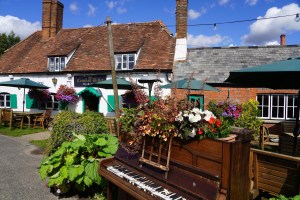
b. The Crooked Billet in Stoke Row, a tiny enclave close to Henley-on-Thames in South Oxfordshire is worth the accolades and the elevated price-point. It is a gorgeous traditional English pub set in the countryside with a shabby-chic interior and an instagram-ready garden display of giant rhubarb in wheel barrows and flowers draped across two pianos on the forecourt. The food is exemplary. It’s popular with locals and movie stars alike so you must book even for a mid-week lunch … it was empty when we arrived with our friend Gary and packed when we left.
Berkshire:
Windsor and Eton! Famous for two things:
a. Firstly, Windsor Castle where the King and Queen live when they’re not in one of their other many official royal residences. The Castle was built in the 11th century after the Norman invasion of William the Conquerer. The River Thames runs through Windsor and makes for a picturesque stroll with views across the river towards meadows in Eton. White swans glide gracefully up and down the river and congregate in huge numbers towards the bridge into Eton where tourists buy bags of seed to feed them. Great for a snap of these beautiful birds (protected by law and Royal Decree) against the backdrop of Windsor and Eton Bridge. Windsor is probably one of the most popular destinations in England for tour buses and foreign visitors (alongside London and Shakespeare’s Stratford-upon-Avon). If you want to see the towns without the hordes get there well before 10am or wait until late afternoon. The iconic Changing of the Guards (from the Old to the New) at the Castle takes place at 11am on Tuesdays, Thursdays and Saturdays with the Guards marching through the streets at 10.45am. They are dressed in their iconic red tunics and bearskin hats accompanied by a marching band. Nothing stops the traffic (and the swarming crowds) more effectively than watching the parade of the Foot Guards from the Household Division march from their barracks along the High Street to the Castle. English pomp and ceremony at its finest!
A few years ago we visited Windsor and were distressed at how grungy and dirty it had become – mainly from the effects of over-tourism with trash dumped everywhere. This time we noticed that it’s in much better shape so the town has the Gardner Seal of Approval once again!
b. The second reason that Windsor is famous is because it is my old stomping ground as a teenager and college student! And Eton (the small historic town which lies across the Windsor and Eton Bridge on the opposite side of the River Thames) is home to my infant school Eton Porny Church of England school from the age of 4 through 12. Picture a tiny mini-me in plaited pig-tails sticking out ether side of my head, dressed in white ankle socks and polished black Alice shoes, a Navy blazer emblazoned with the school logo, a white blouse and a grey knee-length skirt … cute, no?! 😉
Eton is small, beautiful, very well-to-do and very well maintained. It has art galleries, jewelry shops, restaurants and the famous Eton College (known for churning out Britain’s future elite politicians together with future powerful businessmen, educating some of our famous actors, humorists, adventurers and explorers alongside the male members of the Royal Family and the sons of foreign leaders and industrialists). The architecture of the town ranges from Tudor to Victorian, Georgian and Gothic and it’s really unmissable if you’re visiting Windsor.
October in Northern England:
Following our month in the Greek islands we returned to the motherland in early October to spend a couple of nights in Cheshire and our final week in the Lake District in Cumbria. Ever the travel optimist, I had visions of crisp autumnal mornings and leaves changing to oranges, golds and crimson shimmering in the breeze against cerulean skies … but this is northern England and there’s a very good reason why Cumbria and the Lakes are so astonishingly luminously green … it’s the cloudiest, wettest place in England 
Cheshire:
We stayed in the small village of Audlem on the Shropshire Union Canal for two nights. It is renowned for its run of 15 locks which, over the distance of 1.5 miles, drop 93ft. Once famous for its “fly-boats” which were pulled by horses it is now frequented by holiday makers who putter up and down the canal in colorful handpainted barges. The canalside towpath makes for a pleasant autumnal walk which is what we did before we met friends Gary, Rob and Rainzley for dinner at The Bhurtpore Inn (great company but for future reference, pretty average food).
Cumbria:
It was only a two hour drive north to our final home for the week in Bowland Bridge, a tiny hamlet in the south of the world famous Lake District. When I say that the region, this small corner of northern England, is world famous, I do not exaggerate. I doubt that there is a day in the year when its tiny villages and small towns are not inundated with tour buses – particularly from Japan. The Japanese have a peculiar fascination and adoration for all things Beatrix Potter – the simplicity of the storytelling and her romanticized view of the English countryside. Her books of the adventures of fluffy-tailed bunnies, hedgehogs and kittens were based on various lakes and villages in the Lake District and the very popular World of Beatrix Potter Attraction is located in Bowness-on-Windermere.
We were staying in a bijou but trendy converted blacksmith’s cottage called The Old Smithy (operated by Cassius Living which specializes in Lake District rental properties). The garden backs onto the River Winster, a fast-flowing, narrow, shallow river which flows under the historic stone bridge a few feet from the cottage. From the huge glass floor to celling picture windows we enjoyed epic views over the river, the bridge, sheep grazing in the fields and ancient woodlands. At the top of the hill we could see smoke rising from the chimney of the historic Masons Arms on Strawberry Bank, Cartmel Fell. A two minute walk from our small white-painted cottage is the 17th century Hare and Hounds pub which served good food with a very friendly smile. The Masons Arms country inn and hotel was equally friendly with a log fire burning constantly in the grate but the food was not quite so vegetarian friendly so we didn’t eat there. The view from the terrace at the inn was sweeping and very grand stretching for 15 miles across a patchwork of fields and forest with a bird’s eye view over the stone bridge at Bowland Bridge and a cluster of white-painted cottages, one of which was ours 😁
Back to the weather … it was quite a shock after a summer of never-ending sunshine and warmth. Suddenly, we were plunged into alternating mist and drizzle with a rare brighter spot. My vision of crisp autumnal days to end our epic summer in England and Europe was dashed. We were doomed to soggy, muddy walks in the countryside and dusting off our winter jackets, raincoats and hats from the very bottom of our suitcases. During the brief periods when the grey drizzle let up, we did two local walks:
a. The first was a circular hike from the cottage to Cartmel Fell via St Anthony’s Church (built in 1504). We passed hills and fields as emerald as any in Ireland. There were signs of the start of the autumn and the air smelt fresh with moss and damp, dripping foliage. In its way it was quite spectacular.
b. We drove a couple of miles to the car park at the start of the Gummers How hike. Despite my protestations (I still had a pretty sore broken big toe courtesy of my own stupidity tripping over a concrete step at full pelt in Paros, Greece) Geoff took the hardest, most awkward, rocky route with ankle-twisting divots and plenty of hidden obstacles to stub my toe on! The clouds were still rolling in around us but we had occasional glimpses of the views into the distance. On a clear day the view would have been one of the best in the Lake District stretching from Newby Bridge and Lakeside villages at the southern point of Lake Windermere to Belle Isle (the island off Bowness-on-Windermere) and further north. The view encompassed forests, lakefront properties, high mountains and fells.
Highlights of the region in between downpours (which somewhat limited our explorations):
a. Ambleside at the top of Lake Windermere is pretty. There is a short waterfront with boats for rent and the village has some attractive, ornate Victorian architecture and lots of shops and cafes. We stopped for emergency coffee and cake at Mr H Tearoom which is cute to look at but wasn’t terribly memorable for either its coffee or its cake. We took the short trail from Force Cafe and Terrace (a well-known stop for cyclists and hikers in the area serving excellent brunch and coffee) to Stock Ghyll Force (a 70 foot waterfall) on a tributary of the River Rothay just outside of town.
b. Windermere village is also pretty. Homegrown Coffee and Kitchen serves excellent food, coffee and cakes. Thankfully, we visited one day mid-week when we walked straight in. We passed it on our one sunny day at the weekend and the line was not only out of the door but snaking down the road.
c. The sun shone on our most fun day – walking alpacas at Whinlatter Forest with “Alpacaly Ever After!” (an alpaca and llama rescue centre). We visited with Caroline, one of my old friends from University days back in the mid-1980’s. It wasn’t remotely challenging except for the fact that my “Milky” was a very awkward boy who preferred to “hike” with his face down in the grass chewing clods of vegetation. If I wanted to make any progress at all uphill I had to drag him on his leash using my full body weight to get him to shift his furry butt; Caroline’s “Bolt” spent most of the hike stopping every few feet to have a good ol’ long vigorous scratch of his undercarriage; Geoff’s “Beau” was the only well-behaved alpaca of the trio. Because the sun was shining, the views from the forest towards the town of Keswick and Derwentwater were quite beautiful.
d. The Brown Horse Inn, in the picturesque Winster Valley, and close to Lake Windermere was the highlight up-scale gastro pub of the week in Cumbria. A tiny village with a perfect pub and rural views from the garden. Bookings are essential. The food was absolutely excellent. I’m looking forward to going back next year!
e. We took a scenic drive north from Lake Windermere through Troutbeck and on towards Glenridding and Ullswater. The rugged mountains, in shades of green and rust as the low-lying ferns underwent their autumnal change, were fabulous. It is certainly an area we will explore in much greater depth next summer. We did the short trail to famous Aira Force (waterfall) not far from Ullswater. It is a skinny, 66 foot waterfall drop which flows under an arched stone bridge and reputedly served as inspiration for the great poet, William Wordsworth.
f. Bowness-in-Windermere is the least pretty of the villages we had the opportunity to glance at in between raindrops (which is unfortunate since we’re booked in there for a week next summer!). It is home to the Beatrix Potter Experience so it was heaving busy. I’ll reserve judgement until after our visit next summer!
The near constant drizzle and gloomy wintery skies with those depressing grey clouds which weigh heavy upon your shoulders (let alone on your mood) were a perfectly timed reminder why our winters are definitely best spent back at home in sunny Florida!
Although the sun shone only very briefly, it was a taster of what the Lake District should be when it’s looking its best … and since we’re spending a month there in summer 2026 we’re hoping it will be as fantastic as our summer has been in southern England this year! That might be optimistic, but until I’m proved otherwise, I can but dream!
Categories: Alpaca Farm, Ambleside, Audlem, Bath, Berkshire, Bowland Bridge, Bowland Bridge, Bowness-in-Windermere, Bradford-on-Avon, Cheshire, Cirencester, Corsham, Crudwell, Cumbria, Enford, England, Eton, Gloucestershire, Hiking, Lacock, Lake District, Marlborough, Painswick, Somerset, Stoke Row, Tetbury, The Cotswolds, Travel, Ullswater, Whinlatter Forest, Wiltshire, Windermere, Windsor
 AVID WANDERERS: GEOFF & JENNI'S TRAVEL BLOG