Sawara Chiba, Narita, Tokyo
Photo’s are here or you can just click on the photograph above.
This is the shortest blog I’ve ever written! If you find yourself (as we did) flying into Narita airport and then, 36 hours later, having to fly out of it again en route to South East Asia, don’t despair … there are beautiful places to visit very close by. For the avoidance of doubt, if you’re aim is to visit Tokyo city then you need to fly into Haneda airport which is much closer to Tokyo than Narita.
We do so love this country and are now well-overdue for an extended exploration across its various islands!
Part of our rationale for stopping in Japan for 2 nights (before catching our onward flight to Manila) was to tackle some of the 12 hour time difference between the East Coast of the USA and the Philippines. We failed miserably to do that but our brief trip was a timely reminder as to how much we had enjoyed our 2 weeks in Tokyo 11 years ago. Our flying visit was during the first few days of February which is deepest winter in Japan. We took a risk on the weather and it was chilly but sunny (a few days after we arrived in Manila, Tokyo had snow – record amounts of the white stuff – for which we would have been wholly unprepared!).
We had booked into the Hilton Narita which is a monstrous semicircular concrete building on a hill overlooking the motorway not far from Narita airport. It is totally devoid of any of the architectural charm you might expect to see in Japan. It’s also showing its age. We had to break through the ice before stepping into the indoor pool (clearly the Japanese are a hardier bunch than us Floridians!) and the restaurant was very average so we wouldn’t stay there again given the choice! However, they did operate a free shuttle to Narita Station about 10 minutes away which was very handy!
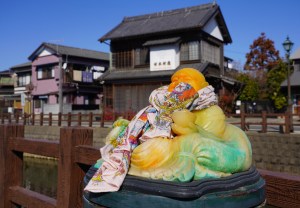
We had a full day to explore after arriving in Narita the night before and, although we were running on fumes, we decided to buy tickets at the station and take the 30 minute train ride to the very pretty historic Edo-period (1603-1867) town of Sawara on the willow-tree lined Ono River. The journey passed through open countryside with rice paddies and small villages. Sawara Chiba is famous for its restored wooden merchant houses and beautifully preserved architecture. Its wooden “Ja-Ja Bridge” also becomes a conduit for a waterfall twice every hour which is relatively unique, I’m sure! The canal was used for 200 years as a critical mode of watery transport and as a result Sawara prospered mightily as a major hub for rice shipments throughout the region. Aside from the delightful historic architecture we struck lucky with some early flowering cherry blossom (sakura) which was an unexpected delight. We enjoyed spotting the various sculptures and art as we strolled along the waterside. I particularly loved the bright orange Buddha – someone had thoughtfully draped a colorful scarf around his neck to keep him warm 😉 I’m sure the town is also very pretty in spring once the willow trees lining the canal burst into life. You only need a few hours to wander through the stores and along the waterway which was perfect since we could barely function on the limited sleep we’d had over the past 2 nights.
We had a whole morning free again the following day before we had to be back at Narita airport to catch our flight to Manila early evening, so we took advantage of the free shuttle which dropped us back at Narita Station again. From there you can walk through the city streets of Narita following your GPS downhill through Naritasan Omotesando (a colorful tourist street with shops selling interesting snacks and decorative ornaments). It took about 20 minutes to walk before we arrived at Somon Gate – the entrance to one of the most spectacular Buddhist temple complexes we’ve ever seen – the Naritasan Shinshoji Temple. Upon entering you will see an impressive rock garden with ponds and then the beautiful Nioman Gate at the top of stone steps where you pass under a bronze “bonsho” bell and a huge red-and-white, ball-shaped paper lantern called a “chochin” which signifies the entrance to a sacred place and functions as a beacon to guide visitors towards the light of Buddha’s teachings.
The 10th century Temple complex covers a huge area with a spectacular central showpiece, the Great Pagoda of Peace. This multi-colored red, gold and blue painted three-tier pagoda is breathtaking. The smell of incense filled the air as smoke billowed from the incense burners as we stopped to watch the devout offering up prayers. We wandered past wooden racks overloaded with “Ema” which are small wooden plaques where visitors to the temple write prayers or wishes and hang them up for Buddha to receive them. To the right and rear of the main buildings lies Naritasando Park, a leafy respite with pagodas, benches and huge carved stone monuments called “somokuto” under the shade of the forest which are carved to honor the spirit of trees and the natural world. It was serene and peaceful and, even better, we found more pink and white cherry blossom! We timed the end of our visit perfectly to witness a procession of monks making their way up the steps to the temple, which, according to a local guide is a one thousand year old tradition here.
If you have even more time or energy to spare you could visit AEON Mall Narita but that would be right at the bottom of our list of things to do when you are in a country as enticingly beautiful and enchanting as Japan ❤️
Categories: Japan, Narita, Sawara Chiba, Tokyo, Travel
 AVID WANDERERS: GEOFF & JENNI'S TRAVEL BLOG